
Workshop
From Regional Dialogue to Concrete Cooperation: HSS Connects Northeast and Central Asia
How can regional cooperation emerge in a region where geopolitical rivalries, historical conflicts, and differing political interests stand in the way of closer cooperation? The Hanns Seidel Foundation has been addressing this question in Northeast Asia for several years. Through a series of expert dialogues in Mongolia, it brought together experts from the Republic of Korea, Japan, China, Mongolia, Central Asia, and Europe to combine different perspectives on regional security, confidence-building, and potential areas for practical cooperation.
This approach evolved step by step. Early workshops initially focused on the security situation in Northeast Asia and on the question of what forms of dialogue remain possible even under difficult political conditions. In addition to traditional security issues, the focus increasingly shifted to areas where shared interests can facilitate concrete cooperation—such as environmental and climate protection, energy, economic integration, and scientific and technological cooperation. Given its foreign policy tradition and its location between Northeast and Central Asia, Mongolia plays a special role as a platform for regional exchange.
This approach was further systematized at the international workshop “Understanding the Past, Shaping the Future,” held in Ulaanbaatar in June 2026. Experts from Northeast Asia, Central Asia, and Europe compared national conceptions of regional order and examined the conditions under which trust and dialogue can be maintained despite growing strategic competition. At the same time, the European and German perspectives were more closely integrated. The workshop was deliberately designed as the beginning of a longer-term process involving a joint publication and ongoing exchange in Germany.
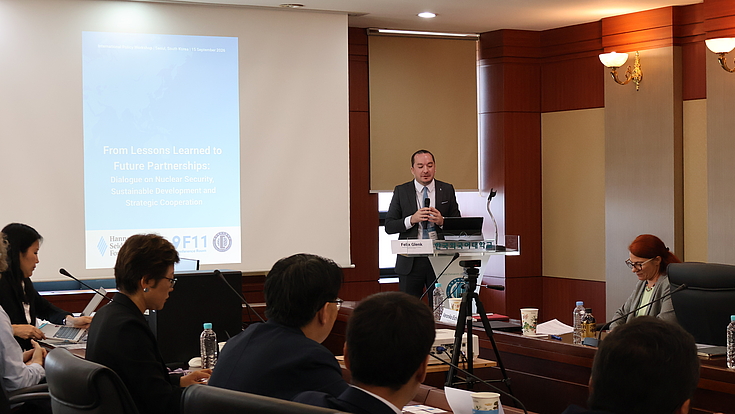
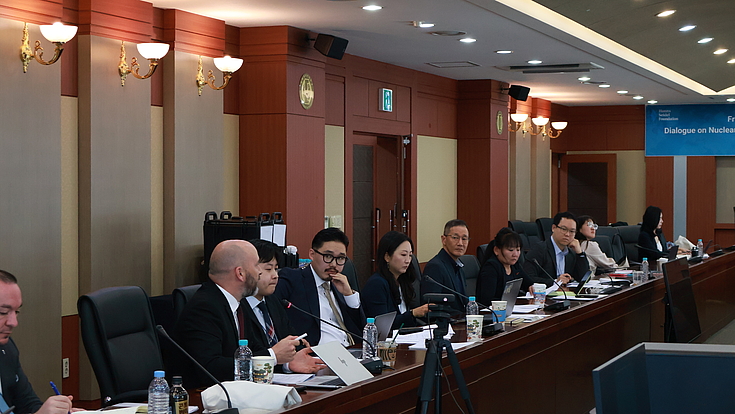
The workshop in Seoul continued this process at a particularly politically significant moment. Deliberately scheduled immediately before the first Korea–Central Asia Summit, the HSS offices in Korea and Central Asia, in collaboration with Hankuk University of Foreign Studies, organized the policy workshop “From Lessons Learned to Future Partnerships: Dialogue on Nuclear Security, Sustainable Development, and Strategic Cooperation.” This brought a new question to the forefront: How can the common interests identified in recent years be translated into more concrete forms of interregional cooperation?
Participants from Kazakhstan, Kyrgyzstan, Uzbekistan, Tajikistan, Japan, Mongolia, the Republic of Korea, and Germany discussed issues related to security, energy, technology, and economic policy. A key focus was on nuclear security and nonproliferation. Central Asia’s experiences were not viewed as a transferable model for the Korean Peninsula, but rather as a starting point for a comparative exchange on how trust, credible commitments, and institutional cooperation can emerge even under difficult security conditions.
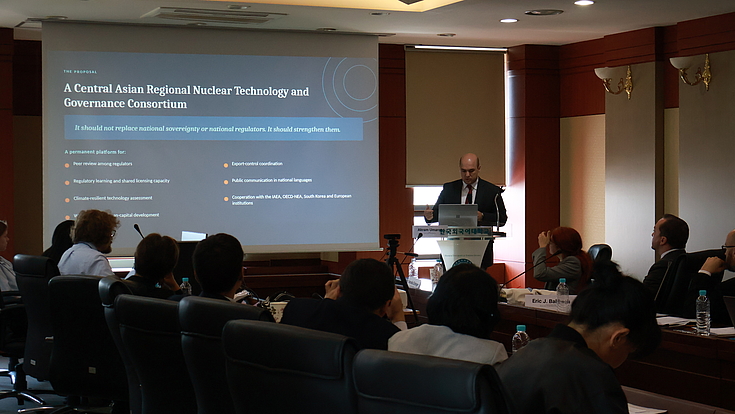
At the same time, the focus was deliberately placed on areas of functional cooperation. Topics discussed included the peaceful use of nuclear energy and small modular reactors, cooperation on energy and raw materials, resilient supply chains, artificial intelligence, digital transformation, and regional connectivity. It is precisely in these areas that points of convergence between South Korea and the Central Asian states become apparent: technological and industrial capacities on the one hand, and energy, raw material, and development potential on the other. The goal here is not cooperation for its own sake, but rather the question of how partnerships can be diversified, dependencies reduced, and economic and political room for maneuver strengthened. This logic also aligns with regional discussions on strategic autonomy and connectivity that have already taken place in Mongolia.
For the Hanns Seidel Foundation, this also represents a special function of its regional work. Its offices in Korea, Mongolia, China, and Central Asia can bring together actors who often work in separate regional contexts. At the same time, the Foundation links these discussions to Germany and Europe. Perspectives and interests from the partner countries should be incorporated more strongly into political debates in Munich, Berlin, and beyond; conversely, German and European experiences can be brought into the regional dialogue processes.
The Seoul workshop was therefore not a conclusion, but rather another step in a long-term process. The networks formed and the expert discussions held are to be continued following the Korea–Central Asia Summit, explored in greater depth in joint publications, and linked to Germany through further exchange and delegation programs. In this way, individual expert dialogues are gradually evolving into an interregional forum for exchange between Northeast Asia, Central Asia, and Europe.