
Conference
Environmental Cooperation as a Door Opener on the Korean Peninsula and Northeast Asia
From Traditional to Non-Traditional Security
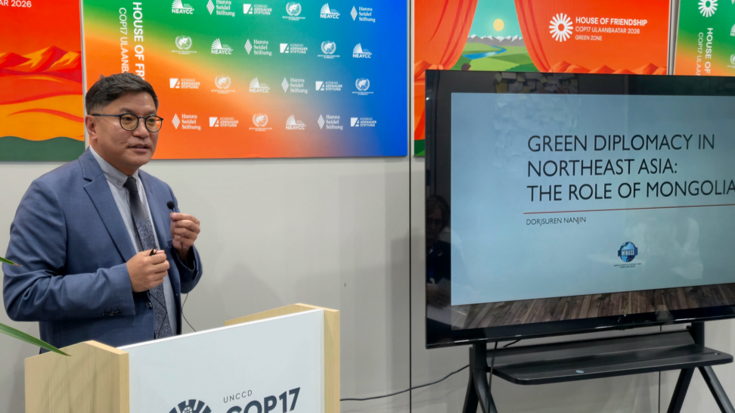
Dr. Nanjin Dorjsuren presented the concept of green diplomacy as a form of international cooperation. He explained the importance of sharing experiences and expertise in environmental security, which is crucial for reducing disaster risks and ensuring safe living conditions. He proposed Mongolia as a potential hub for green diplomacy in Northeast Asia, identifying possible areas of cooperation between neighboring countries, including renewable energy, air pollution reduction, access to safe drinking water and sanitation, and the restoration of ecological systems.
On 25 August, the Hanns Seidel Foundation hosted a side event under its North Korea project on environmental cooperation as a means of building trust on the Korean Peninsula and in Northeast Asia. While political dialogue in Northeast Asia, and particularly on the Korean Peninsula, remains difficult, environmental cooperation has historically provided opportunities for dialogue even during periods of political tension.
Our invited speakers offered a diverse range of perspectives on how environmental cooperation can contribute to trust-building, regional dialogue and peace.

Different Regions Need Different Doors
“Sometimes diplomacy begins with a bird,” explained Ms. Jennifer George. Using the East Asian-Australasian Flyway Partnership (EAAFP) as an example, she illustrated how regular cooperation, even on a small scale, can create significant long-term impact. By working towards a common goal and facilitating the exchange of local knowledge, regional networks can foster shared commitment, strengthen cooperation and gradually build trust across national borders. The common goal to protect a shared ecosystem and migratory birds even manage to transfer through borders that overwise would remain closed due to political differences.

Training the Next Generation of Peacebuilders
Ms. Khishigjargal Enkhbayar highlighted the importance of youth involvement through platforms such as the Northeast Asia Youth Climate Council (NEAYCC), which enables young people from Mongolia, China, Japan and the Republic of Korea to contribute directly to environmental policy discussions in the region. The NEAYCC forms part of broader regional peacebuilding efforts and encourages youth participation in climate-related decision-making. Through multi-stakeholder cooperation, young people receive training on climate- and security-related issues and are encouraged to engage proactively with national governments and international organizations.
The Environment Is Vital to Human Security
The key message of the event resonated strongly: environmental cooperation holds particular potential on the Korean Peninsula, where formal political dialogue remains difficult but both North and South Korea face environmental challenges that transcend the inter-Korean border. Whether through green diplomacy, flyway protection or youth participation, environmental issues can provide practical entry points for engagement.
Even small-scale but continuous engagement and joint problem-solving can help build trust across borders, foster communication and bridge political differences.
Environmental cooperation therefore provides not only practical solutions to shared challenges, but also valuable opportunities to maintain dialogue and strengthen regional cooperation beyond traditional diplomatic channels. On the Korean Peninsula, it creates space for civil society, experts and non-governmental organizations to contribute to trust-building through concrete environmental cooperation, even when opportunities for formal engagement are limited.