
Trip
Strengthening Conservation and Regional Cooperation in Northeast Asia through Joint Field Research
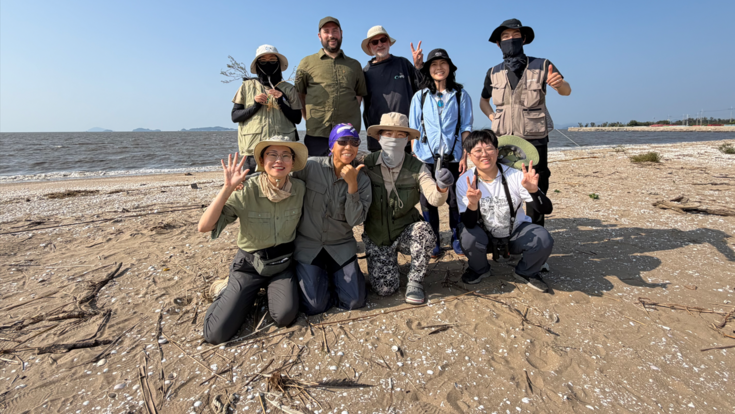
From 26 to 30 September 2026, HSF Korea, in cooperation with the East Asian-Australasian Flyway Partnership (EAAFP) Secretariat, Royal Society for the Protection of Birds (RSPB), Meet Green, Incheon National University, Kyung Hee University, and Seoul National University, conducted an expert meeting and field survey on Yubu Island in Seocheon, Republic of Korea. The activity focused on the Spoon-billed Sandpiper, with particular attention to habitat conditions, major conservation challenges, and priorities for future research and international cooperation.
Experts conducted scan-sampling surveys during falling and high tides to assess the number of Spoon-billed Sandpipers using the area. Particular attention was given to juvenile birds, with the survey results expected to contribute to a better understanding of both the local population and broader population trends.
The team also tested various trapping methods to capture and mark individual birds. If a Spoon-billed Sandpiper was successfully captured, the research plan included:
· Considering the deployment of a 1.2 g solar-powered Platform Transmitter Terminal (PTT) on a juvenile bird to track its southward migration
· Collecting feather samples for DNA and stable isotope analyses
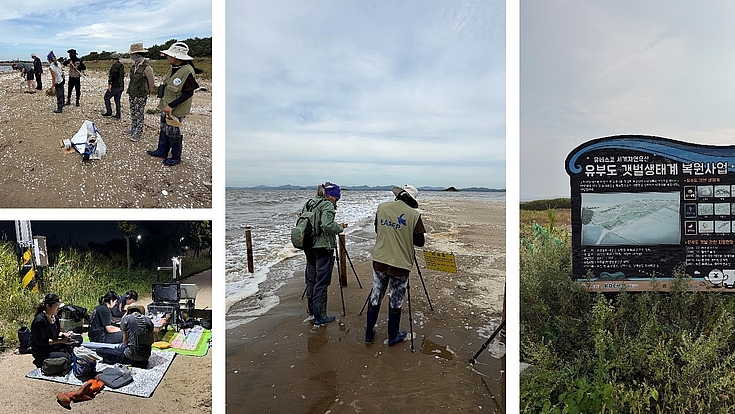
2 PTTs were prepared for the survey. Before deploying any transmitters, the team planned to assess potential predation risks from raptors on the island. The team may analyze any collected feather samples in Korea, with support from the EAAFP Spoon-billed Sandpiper Task Force. Participants also reviewed the GPS tracking equipment and discussed its potential use for migration research. The 1.2 g solar-powered PTT is designed to record the bird’s movement routes, length of stay at stopover sites, and travel time between sites. The tracking data would help researchers better understand the Spoon-billed Sandpiper’s southward migration and identify key stopover and staging sites requiring conservation attention.
The activity provided an important opportunity for international and Korean conservation specialists to exchange field knowledge and technical expertise. It also strengthened cooperation in monitoring and conserving the Spoon-billed Sandpiper along the East Asian–Australasian Flyway.
The meeting and field survey laid the groundwork for continued joint research, monitoring, and information exchange, while contributing to broader transboundary environmental cooperation across the Flyway. The EAAFP Spoon-billed Sandpiper Working Group will share the detailed results of the activity.