
Research Workshop on Natural Resources and Scientific Integration during German Unification
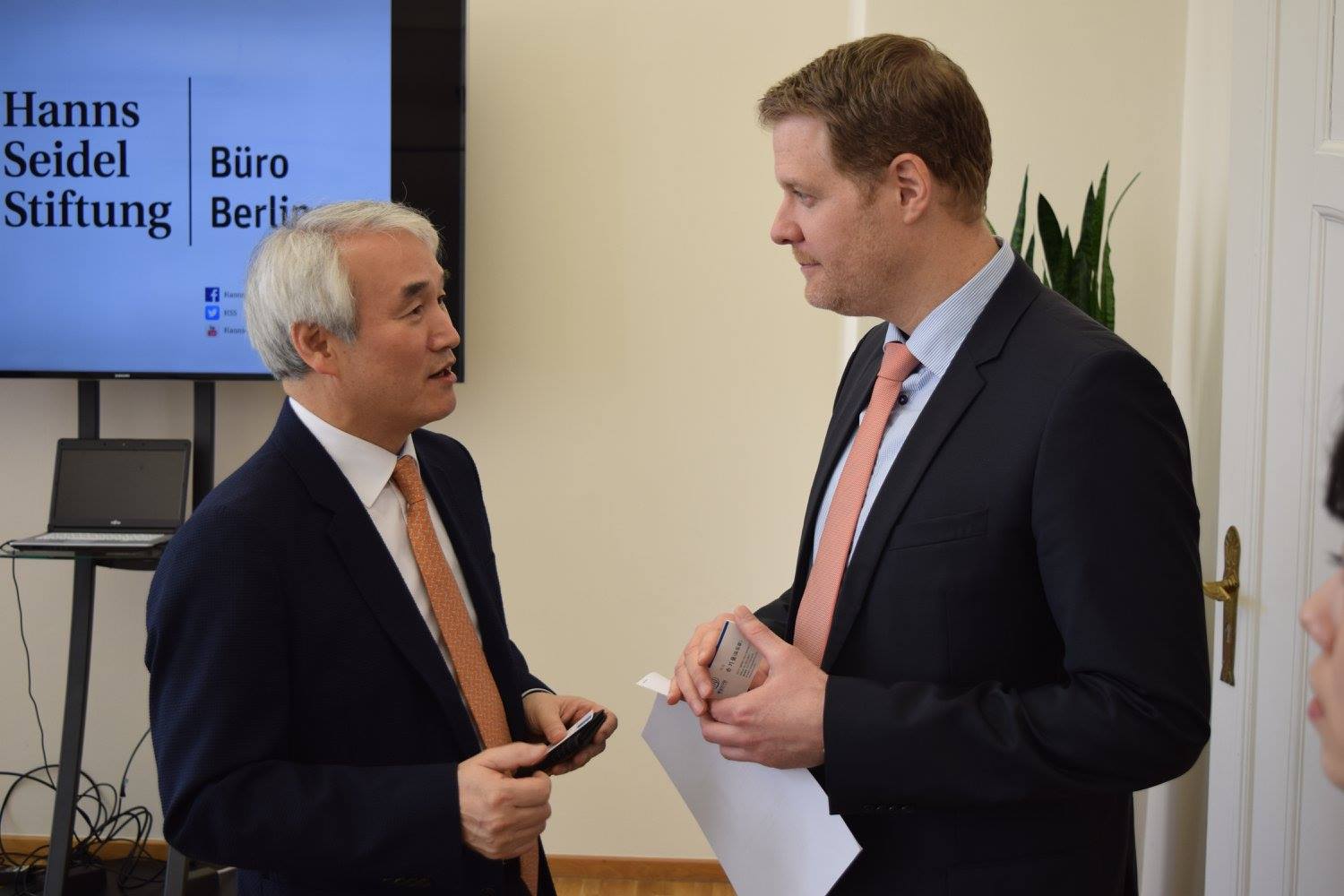
The seminar was opened by Dr. Alexander Wolf, head of the Berlin office of Hanns-Seidel-Foundation.
The seminar was opened by Dr. Alexander Wolf, head of the Berlin office of Hanns-Seidel-Foundation, who gave some short insight into the challenges of German unification. A congratulatory message came from Dr. Son Gi-Woong, president of the Korean Institute for National Unification. Afterwards, four presenters looked back at natural resources and science in German unification. Kerstin Wagenknecht of the German Federal Ministry of Finance gave an overview of economic integration and privatization of the East German economy. Prof. Dr. Gert G. Wagner of the renowned German Institute for Economic Reasearch (Deutsches Institut für Wirtschaftsforschung DIW) looked back at the integration of science in Germany after unification.
Dr. Wolfgang Matz of the Helmholtz Gemeinschaft, an association of 18 independent research institutes of natural and medical sciences representing international cutting edge research, described the experience of integration advanced science in East and West. Finally, Dr. Friedrich-Carl Benthaus of the Lausitzer-Mitteldeutsche Bergbau-Verwaltungsgesellschaft, a society founded to rehabilitate large-scale open lignite mining areas in East Germany, reported on the success of creating new landscapes out of former environmental disaster areas in East Germany, among them creating a large new recreational lake landscape.
After the workshop, courtesy to LMVB also a trip to the rehabilitation area was possible. Certainly, challenges in a case of future Korean unification might be different and probably will be greater than in Germany, but this workshop contributed to increase the understanding of challenges for KIGAM, an important player in future science and natural resource integration for Korea.