
Conference
Strengthening Geopolitical and Economic Resilience through International Cooperation
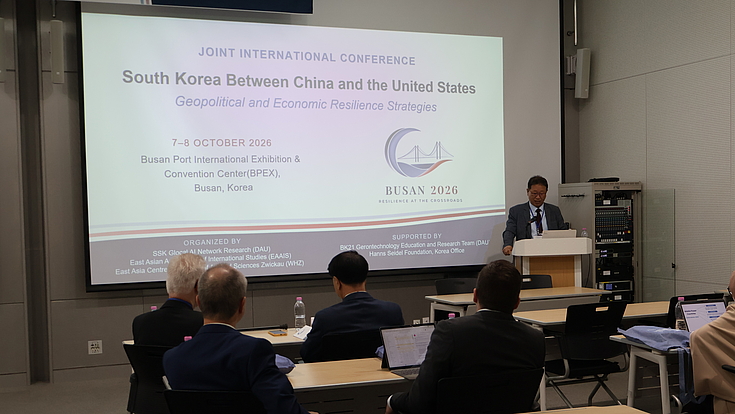
On 7–8 October 2026, international scholars and experts gathered in Busan for the Joint International Conference “South Korea Between China and the United States: Geopolitical and Economic Resilience Strategies.”
The two-day conference, held at the Busan Port International Exhibition & Convention Center, was organized by Dong-A University’s Center for Glocal AI Network Research in cooperation with the East Asian Association of International Studies and the East Asia Centre of the University of Applied Sciences Zwickau, Germany. Through its support for the conference, the Hanns Seidel Foundation Korea reaffirmed its commitment to promoting international dialogue, academic exchange and regional cooperation in Northeast Asia.
Discussions gave a particular spotlight towards South Korea's strategic position between the United States and China and the implications of intensifying great-power competition for Northeast Asia and beyond. Bringing together researchers and experts from South Korea, Germany, Japan, China, Indonesia and other countries, the conference at Busan became an arena for exchanging perspectives on geopolitical rivalry, economic security, technological transformation and regional cooperation.
Navigating Geopolitical Rivalry and Economic Uncertainty
The opening keynote session examined South Korea's historical experiences and the challenges of maintaining resilience amidst growing international uncertainty. Professor Suk-Jun Lim of Dong-A University highlighted the country's position at the crossroads of major geopolitical developments, emphasizing the importance of supply-chain resilience, pragmatic foreign policy, and effective governance. He further emphasized that national resilience extends beyond economic and military capabilities, with a fundamental dependence on strength and adaptability.
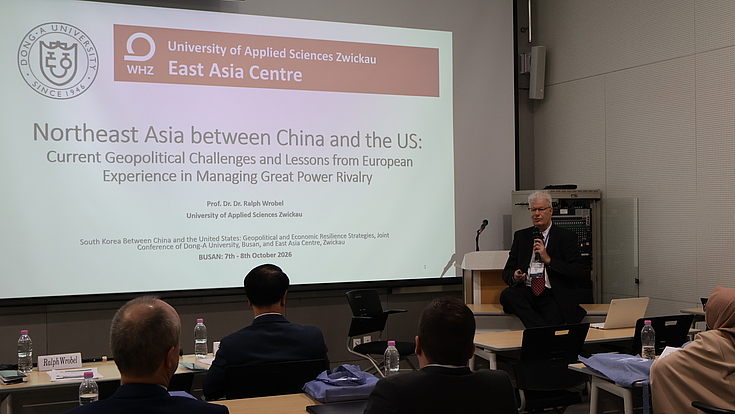
Professor Ralph Wrobel of the University of Applied Sciences Zwickau offered a comparative European perspective on geopolitical competition and economic interdependence. Drawing on Europe's experience of managing great-power rivalry and developing regional economic integration, he discussed the challenges facing Northeast Asian countries and the potential of institutionalized cooperation to strengthen resilience. Particular attention was given to the differences between European and Northeast Asian security structures and the importance of cooperation among countries facing similar vulnerabilities.
Building Resilience through Economic and Technological Cooperation
Throughout the conference, thematic sessions addressed the growing importance of economic security in international relations. Participants examined vulnerabilities in global energy and semiconductor supply chains, changing international financial structures and the strategic choices facing middle powers such as South Korea, Kazakhstan and Indonesia.
A recurring theme was the importance of moving beyond purely national responses to shared challenges. Through diversified partnerships, knowledge exchange and complementary forms of multilateral cooperation, countries can strengthen their capacity to respond to economic disruptions and geopolitical uncertainty.
Strengthening International Academic Exchange
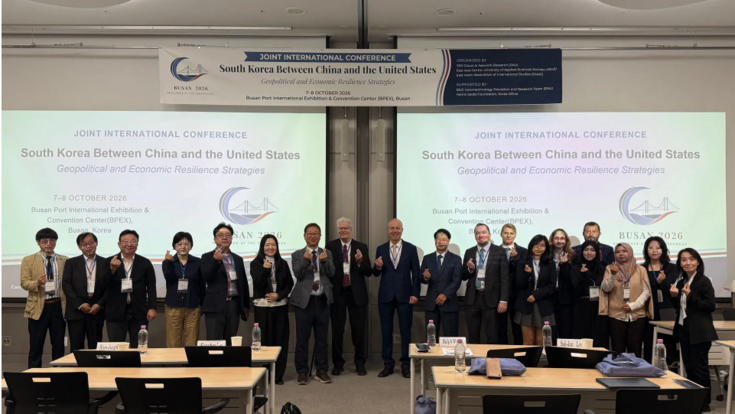
Beyond the substantive discussions, the conference highlighted the value of sustained international academic cooperation.
Exchanges between South Korean and German researchers demonstrated how bilateral cooperation has evolved from primarily one-directional knowledge transfer into a more reciprocal partnership, allowing both sides to learn from each other's institutional, technological and societal experiences.
While earlier exchanges had largely focused on South Korea learning from and drawing on German institutional models, the relationship has increasingly developed into a partnership characterized by mutual learning. Today, Germany also benefits from South Korea's technological advancements and societal experiences.
The conference provided an opportunity to strengthen academic networks, exchange comparative perspectives and identify common challenges across regions. In an increasingly uncertain international environment, continued dialogue and cooperation between researchers, institutions and countries remain essential for fostering mutual understanding and developing practical responses to shared challenges.